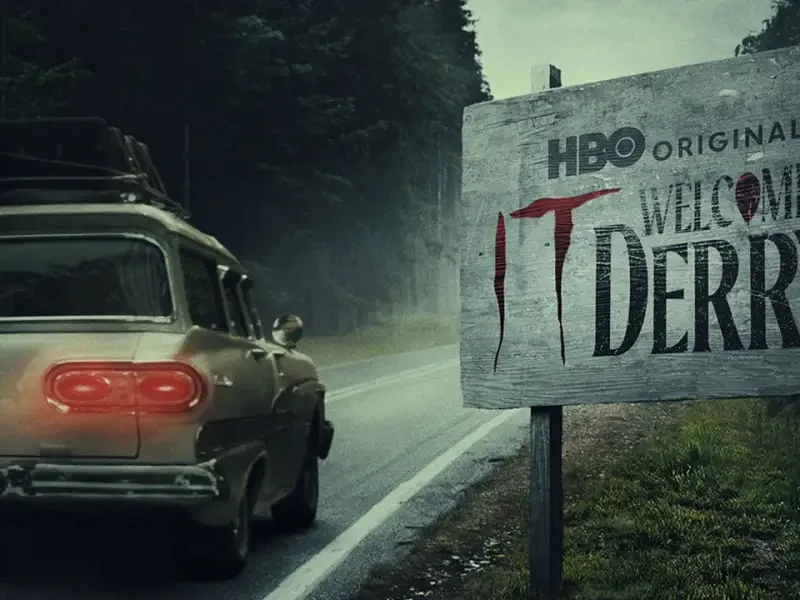


As a lifelong horror fan and someone who has spent years wandering through the pages of Stephen King’s worlds, it actually took me a while to sit down and gather my thoughts about Welcome to Derry. Friends kept asking me for recommendations, and every time the question came up, this show hovered in the back of my mind like a whisper from the sewers. Eventually, I gave in and decided to write about it, because Welcome to Derry isn’t just another horror series; it’s a return to a place that has shaped so much of what I love about the genre.
Set in 1962, the show pulls us back into the cursed town long before the Losers Club ever faced Pennywise. What surprised me most was how confidently it expands the mythology, leaning into the cosmic horror that King only hinted at. The series embraces the idea that Derry’s evil began with an outer‑space meteor that crashed into the land long before the town existed, a meteor that didn’t simply bring Pennywise’s presence but also wrapped Derry in a strange, protective influence, allowing the town to thrive while feeding on the darkness beneath it. That blend of small‑town Americana and extraterrestrial dread gives the show a tone that feels both familiar and newly unsettling.
The characters anchor the story with a mix of vulnerability and grit. Charlotte Hanlon carries a quiet strength that makes her scenes linger long after they end, while Leroy Hanlon adds emotional weight to the Hanlon family’s connection to Derry’s history. Chris Chalk brings a young Dick Hallorann to life with a sense of intuition and unease that King fans will immediately recognize, and General Francis Shaw, along with Chief Clint Bowers, embody the institutional rot that lets Derry’s horrors fester. The younger cast members, Marge Truman and Lilly Bainbridge, deliver performances that are both tender and terrifying, reminding us that in Derry, childhood is never safe. And of course, Bill Skarsgård returns as Pennywise, slipping back into the role with that uncanny blend of charm, menace, and something almost alien, as if the meteor’s influence still pulses through him.
The show doesn’t shy away from gore, and some scenes genuinely made me sit back and breathe for a moment. There is a sequence where a victim’s body twists into a grotesque marionette shape, joints bending in ways that feel physically impossible, as Pennywise “plays” with them like a broken toy. Another moment takes place in a hallway drenched in blood, the walls pulsing as if they are alive and breathing, turning the space into something organic and hostile. The flashback to the meteor’s arrival is one of the most disturbing scenes in the series, showing early settlers torn apart by something they cannot comprehend, a moment that feels almost Lovecraftian in its scale and brutality. The reimagining of the Black Spot is equally intense, filled with visceral detail that left me stunned and reminded me why King’s stories have stayed with me for so long.
What impressed me most was how the show balances atmosphere with mythology. It captures the claustrophobia of a town that refuses to acknowledge its own sickness, the generational trauma that seeps into every family, and the cosmic weirdness that makes Derry feel like a place where reality itself bends. It isn’t perfect, and there are moments where the visual effects wobble or a subplot stretches a little thin, but the overall experience is rich, eerie, and deeply satisfying for anyone who loves King’s universe.
If you’re a horror fan, especially one who grew up with Stephen King’s stories the way I did, Welcome to Derry is absolutely worth watching. It’s unsettling, ambitious, and occasionally stomach‑turning in the best possible way, the kind of show that lingers in your mind long after the credits roll. So when your friends ask what they should watch next, don’t hesitate, send them straight back to Derry, and let them discover the darkness for themselves.