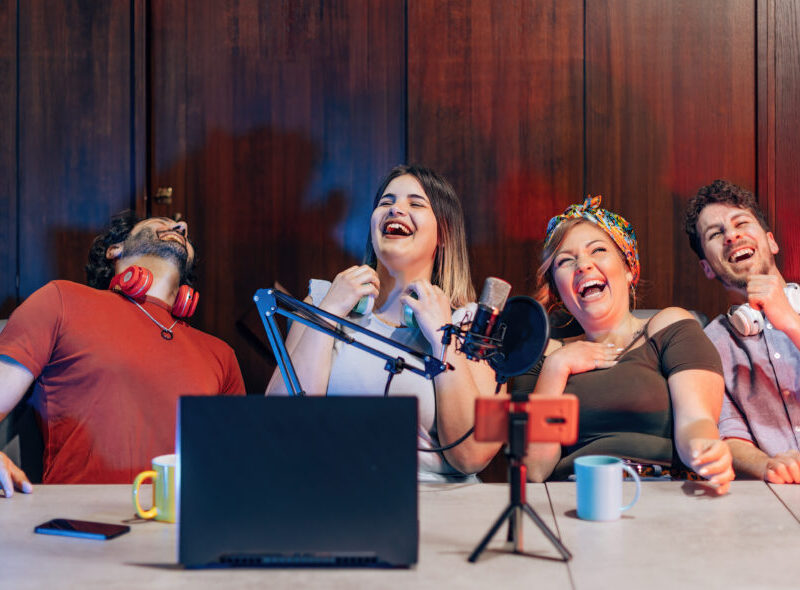


Cultural differences often show up in the smallest, most unexpected ways, and that is exactly what this episode of Language, Lah! explores. Hosted by Gen and Andrea, the episode takes a closer look at how everyday experiences can feel completely different depending on whether you are in Malaysia or the United States. Through their shared experiences, they unpack the subtle but meaningful differences that shape how people behave, communicate, and interact.
One of the first topics they discuss is tipping culture, which can be surprisingly confusing for Malaysians visiting the U.S. In Malaysia, tipping is not expected at all, and in some cases, leaving extra money might even result in someone returning it. Service charge is usually already included, making the process straightforward. In contrast, tipping in the U.S. is a strong social expectation. It is not optional, and failing to tip can be seen as rude. Andrea reflects on how unfamiliar this was when she first arrived, recalling a moment when she nearly walked out after paying for a service, only to realize that tips were not included. Over time, she came to understand that tipping plays an important role, especially since many service workers rely on it due to lower base wages. What initially felt inconvenient eventually became something more understandable, even meaningful.
The conversation then shifts to greetings, another area where cultural differences are immediately noticeable. In Malaysia, people tend to keep to themselves, entering a shop, making a purchase, and leaving without much interaction. In the U.S., however, casual greetings like “How’s it going?” are part of everyday social behavior. Andrea shares how confusing this felt at first, as she was unsure how to respond in such situations. With time, she learned that these greetings are not meant to invite deep conversation, but simply serve as a polite social exchange. This difference reflects broader cultural values, where Asian societies often emphasize modesty and reservation, while American culture leans toward openness and expression. Eventually, this became second nature to her, to the point that she now carries this habit even when returning to Malaysia.
Driving is another topic that highlights how deeply ingrained cultural habits can be. Malaysia follows left-side driving, while the U.S. operates on the right. Although this may sound like a simple adjustment, the reality is far more disorienting. Andrea describes how even now, she occasionally approaches the wrong side of the car out of habit. Everything feels reversed, from the position of the steering wheel to the flow of traffic. One interesting difference she points out is the “right on red” rule in the U.S., which allows drivers to turn right at a red light after stopping, unless otherwise indicated. In Malaysia, turning left on red is generally not permitted unless clearly stated, and doing so incorrectly can result in a fine. Adapting to these differences requires more than just understanding rules; it involves retraining instinct and awareness.
Pedestrian rights provide another striking contrast. In the U.S., pedestrians are given clear priority, with cars stopping at crosswalks and drivers patiently allowing people to cross. In Malaysia, the experience can feel much less structured. Pedestrians often need to judge traffic carefully, sometimes pausing in the middle of the road while waiting for a safe moment to cross. Andrea shares how, after getting used to the U.S. system, she instinctively stopped her car for a pedestrian when she returned to Malaysia, only to be met with a honk from the car behind her. It was a small but telling moment that highlighted how habits formed in one culture do not always translate smoothly into another.
Language itself also reflects these cultural differences. While both Malaysia and the U.S. use English, the vocabulary can vary significantly. Malaysian English, influenced by British English, includes terms such as lift, petrol, flat, boot, holiday, and cinema. In American English, these become elevator, gas, apartment, trunk, vacation, and movie theatre. Andrea recalls a moment of confusion when someone mentioned needing to “gas up the car,” which she initially associated with cooking gas rather than petrol. These differences may seem minor, but they can easily lead to misunderstandings while also adding humor and depth to cross-cultural experiences.
Through these discussions, the episode highlights how culture is embedded in everyday life, shaping not only what people do but also how they think and respond to the world around them. Hosted by Gen and Andrea, Language, Lah! offers a relatable and engaging perspective on these differences, reminding listeners that even the most ordinary situations can carry unexpected cultural meaning.