
Working as a medical interpreter through VRI, or Video Remote Interpreting, has given me a front row seat into parts of healthcare most people never get to see. Every day brings different conversations, different emotions, and different medical situations. Some calls are routine, some are heartbreaking, and some quietly remind you just how far medical science has advanced.
One procedure that left a strong impression on me was the placement of a Tunneled Central Venous Catheter, commonly known as a Tunneled CVC.
Before working in medical interpreting, I had heard of dialysis, but never truly understood what patients go through just to receive treatment that keeps them alive. Interpreting these appointments allowed me not only to hear the medical explanations, but also to witness the emotions behind them, the fear, anxiety, discomfort, relief, and sometimes even hope.
What Is a Tunneled Central Venous Catheter (CVC)?
A Tunneled Central Venous Catheter is a special type of catheter, or flexible tube, inserted into a large vein, usually near the chest or neck. It is commonly used for patients who require long term treatments such as:
- Hemodialysis for kidney failure
- Long term intravenous medications
- Chemotherapy
- Nutritional support
- Frequent blood access
Unlike a regular IV line placed in the arm, a tunneled CVC goes deeper into a major vein and is designed to stay in place for weeks or even months.
The word “tunneled” comes from the way the catheter is inserted under the skin before entering the vein. This tunneling helps reduce infection risk and keeps the catheter more secure.
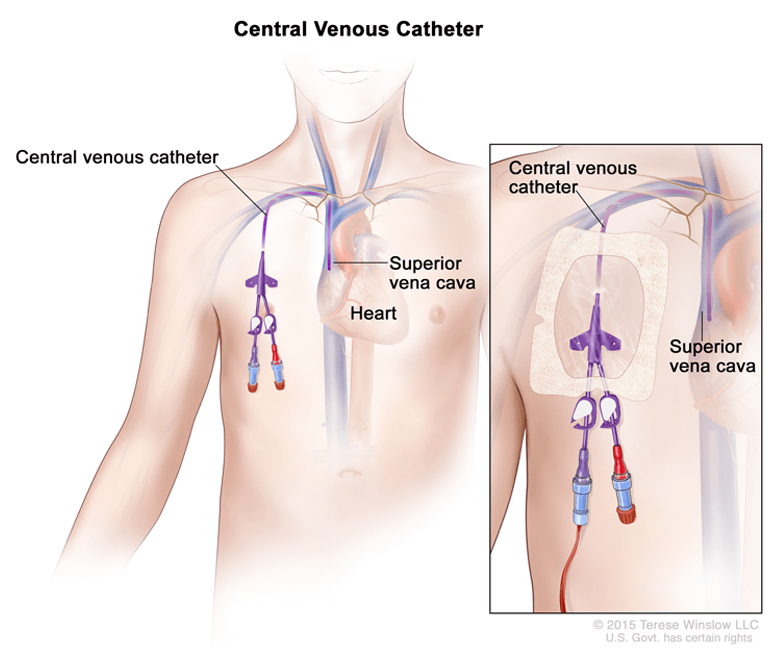
Looking at the diagram above, you can better understand how a Tunneled Central Venous Catheter (CVC) works inside the body during dialysis treatment.
1. The Catheter Entry Site
The catheter is usually inserted through the chest area, just below the collarbone, or sometimes through the neck. This is the visible external portion patients see outside the body.
This area must be kept clean and sterile to reduce the risk of infection.
2. The “Tunnel” Under the Skin
One unique feature of a tunneled CVC is that part of the catheter travels underneath the skin before entering the vein.
This “tunnel” serves several important purposes:
- Helps secure the catheter in place
- Reduces infection risk
- Creates a barrier against bacteria entering the bloodstream
- Allows longer term use compared to regular IV lines
There is also a small cuff beneath the skin that helps tissue grow around the catheter, making it more stable over time.
3. The Large Central Vein
The catheter tip is positioned inside a large vein near the heart, usually the superior vena cava.
This location is important because:
- Blood flow is very strong there
- Dialysis machines require fast blood circulation
- It allows blood to be removed and returned efficiently during treatment
4. The Two Catheter Lumens
Most dialysis CVCs contain two separate channels, or lumens.
One lumen:
- Carries blood from the patient to the dialysis machine
The second lumen:
- Returns filtered blood back into the body
This continuous circulation allows the dialysis machine to clean the blood when the kidneys are no longer able to do so effectively.
How Is It Used for Dialysis?
For dialysis patients, the tunneled CVC acts as an access point for the dialysis machine.
During hemodialysis:
- One tube removes blood from the body
- The dialysis machine filters waste, toxins, and excess fluids
- Another tube returns the cleaned blood back into the body
For many patients, this catheter becomes a lifeline while waiting for a more permanent dialysis access, such as an AV fistula, to mature.
Watching these interactions during interpreting sessions made me realize something important: dialysis is not just a treatment, it becomes part of a person’s daily life, routine, and survival.
The Human Side of the Procedure
One thing medical interpreting teaches you very quickly is that medicine is never just about procedures and terminology.
Behind every explanation is a real person trying to process difficult news.
Some patients are nervous about having the catheter inserted. Others worry about pain, infections, or how their daily life will change afterward. Some are exhausted from repeated hospital visits. Family members often sit nearby, asking questions quietly, trying to stay strong.
As interpreters, we become the bridge between the healthcare team and the patient. We hear the technical side from doctors, but we also hear the trembling voices, the hesitation, and the emotional weight patients carry.
There were moments during dialysis related calls where I found myself quietly reflecting on how fragile health can be. Something as simple as healthy kidneys is often taken for granted until they stop functioning properly.
A Reminder About Health
Experiences like these become reminders that our health is incredibly important.
Modern medicine has advanced in ways that would have seemed impossible decades ago. The ability to filter blood through a machine, place long term vascular access safely, and sustain life through dialysis is truly remarkable.
Yet despite all the technology, the emotional aspect of healthcare remains deeply human.
Patients still need reassurance.
Families still need understanding.
Healthcare workers still carry emotional burdens.
And interpreters stand in the middle of these conversations, helping people understand one another during some of the most vulnerable moments of their lives.
What I Learned From These Calls
Working as a VRI interpreter exposed me to more than medical terminology. It gave me perspective.
It taught me:
- Never take your health for granted
- Small daily habits matter
- Medical science continues to evolve in incredible ways
- Empathy is just as important as treatment
- Communication can make difficult experiences less frightening
Every medical call becomes a learning experience, not just professionally, but personally as well.
Sometimes after finishing a dialysis related session, I sit quietly for a moment thinking about the patient on the other side of the screen. Someone adapting to a completely different lifestyle, facing treatments multiple times a week, yet still trying to live normally.
That level of resilience is something deeply humbling to witness.
Final Thoughts
A Tunneled Central Venous Catheter may sound like just another medical device, but behind it are stories of survival, adjustment, fear, and strength.
As a medical interpreter, I feel fortunate to witness these moments because they constantly remind me how interconnected medicine and humanity really are.
Not only do we get to experience and learn about new medical treatments through interpreting, but we also gain a deeper understanding of what patients physically and emotionally go through during procedures like catheter placement and dialysis.
And perhaps most importantly, it reminds us to appreciate our own health while recognizing how extraordinary modern healthcare has become.