

Sometimes the most meaningful stories do not come from books, films, or even our own lives. They arrive through unexpected encounters with people who see the world differently. Recently, I met a pen pal with one of the most fascinating hobbies I have ever come across. Rather than writing stories, she tells them through illustrations. She listens to someone’s experience and translates it into art, capturing not just what happened, but what it felt like. Every color, every line, and every detail serves a purpose. The illustrations are not entirely literal, yet somehow they communicate emotions that words alone often struggle to express.
As someone who spends countless hours interpreting conversations between patients, families, and healthcare professionals, I immediately found her work intriguing. Interpreters are surrounded by stories every single day, yet most of them remain untold. Confidentiality is one of the foundations of our profession, and rightly so. The conversations we witness belong to the people who lived them, not to us. Even so, there are moments that stay with us because they remind us of the extraordinary humanity hidden within ordinary conversations.
When she asked if there was a story I wanted to share, one particular call immediately came to mind.
It was not a chaotic emergency or a dramatic life-saving procedure. There were no alarms sounding or frantic voices filling the room. Instead, it was one of the quietest calls I have ever interpreted, and perhaps because of that, it became one of the loudest memories I carried home.
An elderly woman was approaching the end of her life. The doctor stepped out briefly to speak with another member of the medical team, leaving her husband alone beside her bed. The interpretation session remained connected because the conversation was not yet finished. During moments like these, interpreters become almost invisible. We are still present, yet we fade into the background, quietly witnessing conversations that were never intended for us, but which we have been entrusted to hear.
The husband gently held his wife’s hand and began talking to her.
He apologized, not for one particular disagreement, but for every argument they had ever shared throughout their marriage. He thanked her for taking such wonderful care of him, for raising their family, and for carrying responsibilities that he admitted he had often taken for granted. His words were not polished or rehearsed. They sounded like thoughts that had been waiting decades to be spoken, finally finding the courage to come out when time had become painfully precious.
There were moments when his voice remained steady, followed by moments when it quietly trembled. Long pauses separated his sentences, allowing silence to say as much as the words themselves. I was not interpreting those conversations. I was simply listening, fully aware that I had become an unseen witness to one of the most intimate conversations a couple could ever share.
Some interpretation sessions end the moment we disconnect.
Others never really do.
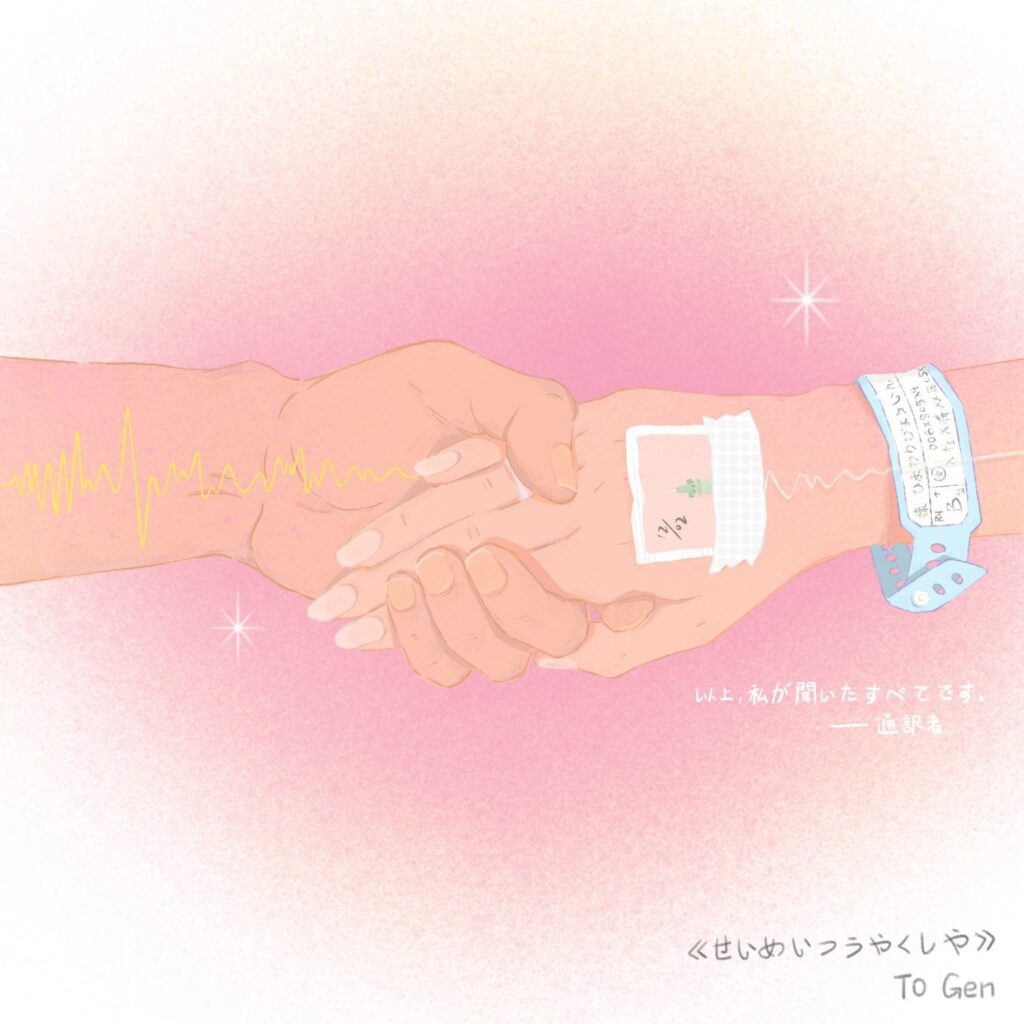
When I shared this story with my pen pal, she listened carefully before creating an illustration inspired by that moment. The artwork was not a literal recreation of the hospital room. There were no walls, no medical equipment filling the scene, and no attempt to reproduce every detail exactly as it happened. Instead, she focused on the emotional truth of the story, trusting symbolism to communicate what realism could not.
At first glance, the illustration appears beautifully simple. Two hands gently hold one another. One hand belongs to the husband, reaching across with tenderness and reassurance. The other belongs to his wife, wearing a hospital wristband and an IV line that quietly reminds us of her condition. The simplicity of the image invites you to pause rather than overwhelming you with details.
Then I noticed something I had completely overlooked.
Running across the illustration are two ECG tracings.
The yellow line represents the husband’s heartbeat, symbolizing the life that continues even as he prepares to say goodbye to the woman who shared it with him. The white line represents his wife’s heartbeat. As it moves across the page, it slowly fades before eventually becoming a flat line, quietly marking the end of her journey.
On their own, they are simply two ECG readings.
Together, they become something much more meaningful.
The yellow and white lines travel alongside one another, weaving through the space between the couple’s hands. They no longer function only as medical monitor readings. Instead, they become the invisible bridge connecting two hearts. They symbolize every word exchanged between husband and wife, every apology, every expression of gratitude, every memory, and every final goodbye.
At the same time, those intertwined lines also represent the interpreter.
Communication is often invisible. Like an ECG tracing, it quietly carries life from one point to another. The interpreter becomes that connecting line, faithfully conveying every emotion, every sentence, and every silence from one person to another without altering their meaning. It is a remarkably subtle piece of symbolism, and one that reveals itself only after spending time with the artwork.
The more I looked at the illustration, the more I realized it was never simply about life ending.
It was about love continuing.
It was about connection surviving even when words become difficult.
And perhaps most importantly, it was about the quiet role interpreters play in making sure those final conversations reach the people who need to hear them.
In the lower corner of the illustration appears a sentence that immediately caught my attention.
以上、私が聞いたすべてです。
“That’s everything I heard.”
— Interpreter
Those words are beautifully simple, yet they perfectly capture the essence of our profession. We cannot add meaning where none exists. We cannot soften painful truths, nor can we remove uncomfortable ones. Our responsibility is to faithfully carry every word across the language barrier, and when the conversation ends, all we can honestly say is, “That is everything I heard.”
For most people, interpretation is simply another service within healthcare. For interpreters, however, it is also an invitation into moments that few outsiders ever witness. We hear fear before surgery, relief after successful treatments, tears during difficult diagnoses, laughter when hope returns, and sometimes, final conversations between people who have spent an entire lifetime together.
Most of those stories will never be shared.
Nor should they be.
Yet every interpreter, regardless of the language they speak or the country they work in, probably carries memories that quietly remain with them long after their headset comes off. Somewhere in the world, another interpreter has listened as a father apologised to his son. Another has witnessed a family saying goodbye. Another has remained connected just long enough to hear words that would become someone’s final memory.
Although this illustration was inspired by one story I experienced, I believe it represents something much larger than a single interpretation call.
It represents every interpreter who has ever quietly stood between two languages while two hearts tried to reach one another.
This illustration is my tribute to them.
It reminds us that behind every interpreted conversation is a human story. Behind every translation is a relationship. Behind every headset is an interpreter who understands that some conversations cannot be remembered because they belong to someone else, yet they are never truly forgotten because, for a brief moment, we were trusted to hear them.